Complex Healthcare Photonics Applications
Flip chip bonding for the µLEDs, laser diodes and chips behind brain-computer interfaces, vision implants and optical diagnostics. Sub-micron accuracy, ultra-low force, little or no heat, and every key process in one system.
Medical optoelectronics are behind some of the most complex medical devices. Light can do four things inside the body that electrical signals do badly: stimulate only the right cells, power an implant without a battery, carry data through the skin, and measure what happens in tissue or blood. Optogenetic brain interfaces, optical cochlear implants and retinal implants all depend on it.
Medical device teams build these neural probes and implants from µLEDs, laser diodes and other optoelectronics on silicon, glass or polymer only a few microns thick. What was lab work ten years ago is now reaching patients, and each device depends on a light source or detector bonded in exactly the right place, on materials the body accepts.
Each part needs its own bonding process, force and temperature, and every joint must be clean enough for the body. With manual assembly and single-process die bonders, results are hard to repeat.
Advanced Packaging for Medical Photonics
Brain-computer interfaces, vision implants and optical diagnostics all rely on optoelectronic components, but each puts different demands on how the dies are bonded, often on fragile substrates. With Finetech’s die bonding platform, engineers place µLEDs, laser diodes, photodetectors and ICs for all three with sub-micron accuracy, gentle force and minimal thermal load, combining every key bonding process in one system.
Brain-Computer Interfaces
µLEDs, laser diodes and CMOS chips bonded onto probes with sub-micron placement, from optogenetic probes to endovascular implants. Fine-pitch flip chip, ACF and hermetic AuSn sealing for joints and seals that have to last at least ten years in the body.
Vision Care / Ophthalmic
Retinal implants depend on tiny light sources, sensors and chips placed on fragile, heat-sensitive substrates. Sub-micron placement and low-temperature, flux-free bonding make the assembly repeatable, from the first prototype to small series.
Photonic Diagnostics & Sensing
Photonic biosensors use light to measure what is happening in tissue or blood. A VCSEL sends the light and a photodiode detects it, so both must be aligned to under 1 µm on the sensor chip for an accurate measurement.
Engineering Reliability for Medical Electronics Manufacturing
Whether it’s photonic implants, medical imaging, patient monitoring, diagnostics or drug delivery devices, Finetech’s die bonding platform offer the accuracy and process flexibility that medical device technologies and rapid prototype development need. With sub-micron placement, ultra-low to high force and ACF/ACP bonding, and small die handling, one platform covers both light-based and conventional medical electronics.

Key Capabilities for Medical Device Assembly
Sub-micron placement and precisely controlled heat profile
Optoelectronic components aligned to 0.3 µm and low-temperature, heat-free bonding
Bonds made to live in the body
Clean, flux-free and hermetic bonds for long-term implants, made with yields of up to 99%.
Every key bonding technology in one system
Thermosonic, eutectic, adhesive, ACF and UV curing.
Controlled bonding force
Precise force control from 0.05 N to 1000 N.
Proven in published medical research
FINEPLACER® systems used in 32+ published brain-computer interface papers.
Supported Die Bonding / Die Attach Technologies
Almost 35 years of experience in precision assembly for the healthcare manufacturing industry including neurotech companies, implant makers, CDMOs and research institutes building bioelectronic and medical devices.
Thermocompression and Thermosonic Bonding
Adhesive Bonding (ACF, ACP) with UV Curing
Eutectic (In-Au, AuSn) Bonding
Ultrasonic Bonding
Heterogeneous Integration
Working with Biocompatible Materials
Advancing Artificial Sight with Precision Bonding
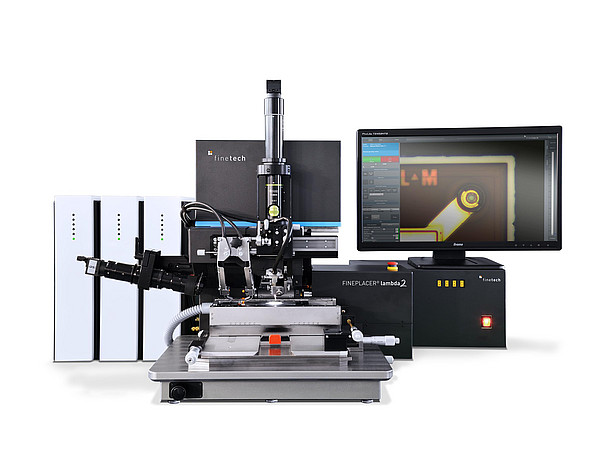
Japanese ophthalmic company NIDEK is developing an artificial retina chip that could help people with visual impairments see again. With a FINEPLACER® lambda 2, the R&D team bonds microelectrodes with sub-micron accuracy and moves through prototype cycles faster.
Recommended Systems

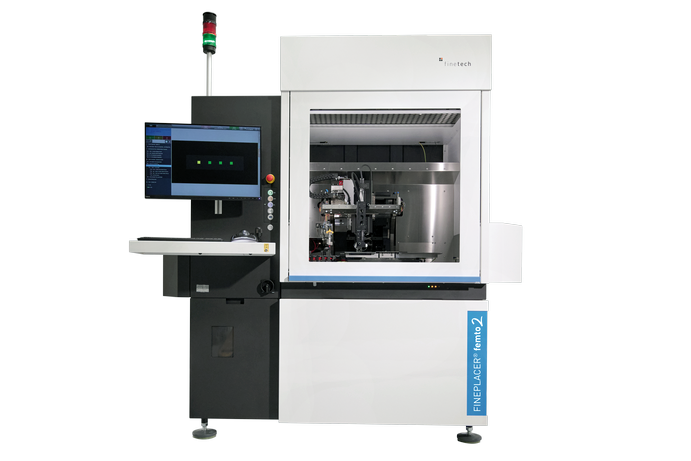
FINEPLACER® femto 2
Advanced Sub-Micron Bonder

FINEPLACER® lambda 2
Sub-Micron Table Top Die Bonder