- Sub-micron die bonding accuracy critical to enable reliable artificial retina devices
- FINEPLACER® lambda 2 shortened development time through stable, repeatable assembly
- Scalable die bonding platform ensures future-ready processes for next-generation medical devices
NIDEK Co., Ltd., a globally recognized Japanese ophthalmic medical device manufacturer, is developing an advanced Artificial Vision System to improve the quality of life for people with visual impairments. During prototyping, the team reached a critical limit. Conventional assembly methods could not reliably achieve the sub-micron accuracy and repeatability required for stable device performance.
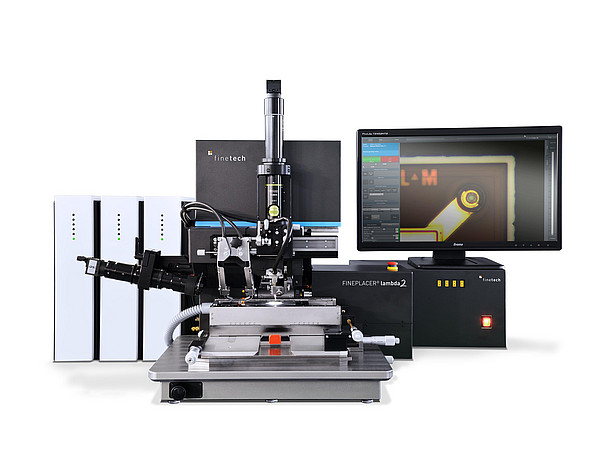
To address this, NIDEK adopted Finetech’s high-precision die bonder, the FINEPLACER® lambda 2. The system enabled stable, high-quality assembly and significantly shortened the development path toward clinical application. Its modular design also provides a platform that can evolve beyond the initial R&D phase.
The Challenge: Precision and Reliability at the Micron Scale
At the core of the system is the artificial retina chip. It must be biocompatible, reliable over long periods, and capable of processing extremely fine electrical signals. This requires bonding large numbers of microelectrodes and ICs with pitches of only a few tens of micrometers. Accuracy of ±1 µm or better is essential, with no tolerance for defects.
NIDEK’s development team faced three central challenges:
- Reproducibility: bonding accuracy had to be fully repeatable and independent of operator skill.
- Yield: early-stage prototypes are costly, making high yield essential despite complex, miniaturized structures.
- Future readiness: the platform needed to support new bonding processes as R&D progressed.
The Solution: a Scalable R&D Platform
Based on Finetech’s proven track record in demanding applications, NIDEK selected the R&D-optimized FINEPLACER® lambda 2 with optional modules. This provided a solution for current micro-assembly requirements while ensuring long-term flexibility.
Key capabilities include:
- Ultra-high precision passive alignment with accuracy of 0.5 µm or better for complex electrode arrays and flip-chip assemblies.
- Advanced process control through optional modules, enabling precise adjustment of temperature, pressure, and atmosphere for different bonding processes.
- Flexible hardware and software that adapt to new materials and bonding methods, removing typical prototyping constraints.
Result: Faster Development and Higher Confidence
The introduction of the Finetech die bonder delivered clear benefits:
- Shorter development cycles through the replacement of manual or unstable assembly steps with repeatable, high-precision bonding.
- Improved connection quality and long-term reliability, meeting the strict requirements of implantable medical devices.
- A future-ready technology base that allows rapid integration of new materials and bonding technologies as development continues.
The Artificial Sight System represents a major step toward restoring human vision. Finetech supports this effort with ultra-high precision die bonding technology and a scalable R&D platform designed to meet the most demanding medical device requirements.